
Wafer inspection machines are crucial in semiconductor manufacturing as they flag surface and pattern defects before wafers advance to expensive stages of processing. Laser or vision-based systems are what these machines rely to scan across wafers mounted on X-Y indexing tables. Inspection accuracy, reliability and output rate is affected by precision motion control which is why it’s vital that these machines can perform accurately.
Engineers that are tasked with building or optimising these machines have to consider issues like repeatable short-stroke motion, real-time positioning feedback and thermal management.
Agile Precision in Limited Spaces
In comparison to long-range gantry systems, wafer inspection platforms need rapid, short-distance movements in both axes, micron-level repeatability, low mechanical vibration (prevention of visual noise in recorded images) and minimal heat generation as optics or precision sensors are used.
Whilst open-loop steppers were once the solution in the past, the risk of step-out under variable loads and the lack of feedback has its drawbacks. As well as this, servo systems may add unnecessary complexity for these compact setups with precision-repeat applications. See this image here.

How Closed-Loop Steppers Solve The Problem
For short, rapid movements, such as in wafer inspections, closed-loop stepper systems are a great alternative. They maintain the key feature of a servo (feedback-driven positioning) and retain the direct control and mechanical simplicity of a conventional stepper motor.
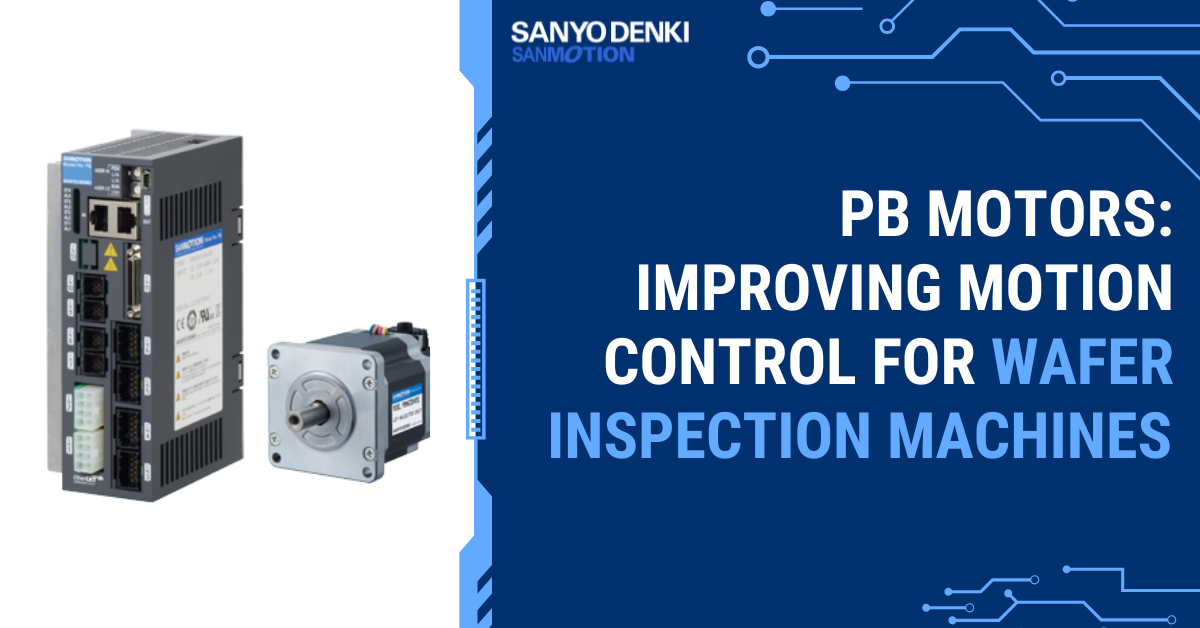
SANYO DENKI’s SANMOTION Model No. PB is a great example of a closed-loop stepper paired with a multi-axis EtherCAT driver that’s been utilised in a tight space. The combination of the two resulted in the following:
- High torque at a reduced speed for fast indexing
- Built-in encoder feedback, stopping step-out and achieving steadier performance
- Reduced vibration; crucial when using camera/sensors
- Smaller, consistent control, supporting multiple axes over a single high-speed communication bus
The result? Engineers can balance responsiveness with stability which means excess energy is not wasted nor is the system over-engineered.
Benefits That Power Your Performance
Engineers, whether you’re working on motion systems in semiconductor tools or other types of automated image inspection applications, SANMOTION PB aids in:
- Decreasing image distortion
- Enhancing thermal stability during long operation cycles
- Saving space by using compact multi-axis drivers to reduce cabinet as well as machine size
- Reducing operation downtime through real-time feedback and recovery from fluctuating load
The advantage to this solution is your system will perform consistently. Less time is spent adjusting and more time improving performance as your system will keep precise alignment through thousands of cycles.
In the ever-growing world of semiconductor wafer inspection, engineers need motion control solutions that offer, low noise, accuracy and thermally stable operation for optimised designs.
Selecting the right motor design can impact precise motion control, whether it’s an indexing table or an integrated optical stage.
Choose the right solution with Motors and Fans. Find out more about our Sanyo Denki PB Motors here and at motorsandfans.co.uk.